Retention of Quality Professors:
Key to a Successful Liberal Arts Education?
The Truman State University’s Chapter of the American Association
of University Professors (AAUP) conducted a study during the fall
semester of 1999 of faculty members who have left the institution
over the past five years. The study indicates that faculty retention
is a serious problem for Truman State University. While the University’s
administration concerns itself with student retention and improvement
of the physical plant, it has done little to address faculty attrition
issues. Arguably, quality professors are the heart of a successful
liberal arts education. The AAUP would like to encourage Truman’s
administrators to implement policy changes which would address
this issue in order to build a stronger institution that will
attract and retain talented faculty members.
AAUP has identified about 200 faculty members who have left
Truman State University over the past five years. Slightly over
half of these departees were faculty on temporary, non-tenure
track contracts. For the most part, this study excludes temporary
workers except perhaps to note that due to their transitory nature
they are probably undercounted and to advise a study on the ramifications
of using temporary and part-time labor in an academic setting.
Also not included are departed staff which would also warrant
an independent study.
Of the remaining departed faculty members, 31 retired (it is
telling that many of these people took early retirement and then
moved onto gainful employment elsewhere), 8 were either denied
tenure or fired, and 48 (almost a quarter) resigned their position
at Truman, usually to pursue gainful employment elsewhere. This
study focuses primarily on this last group of people.
| Aggregate figures for departing faculty,
1995-1999 |
||||
| Division | Tenured | Tenure Track | Temporary | Total |
| Bus. & Acc. | 4 (all retired) | 2 | 2 | 8 |
| Education | 1 (retired) | 1 | 3 | 5 |
| Fine Arts | 5 (3 retired) | 6 | 24 | 35 |
| HPP | 5 (all retired) | 7 | 3 | 15 |
| Lang. & Lit. | 11 (6 retired) | 12 | 29 | 52 |
| Math & CS | 3 (2 retired) | 5 | 13 | 21 |
| Science | 9 (6 retired) | 5 | 18 | 32 |
| Social Science | 5 (4 retired) | 7 | 16 | 28 |
| Total | 43 (31 retired) | 45 | 108 | 196 |
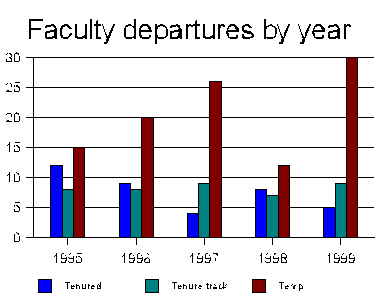
Faculty attrition has a variety of costs and negative consequences
for an institution. These include the following:
- financial costs associated with rehiring faculty positions,
including the expense of travel and interviewing, faculty and
administrative time spent on searches, productivity loss for
faculty and administrative members involved in the search, and
start-up costs;
- impact on students, including a lack of continuity in relationships
built up through classes and advising and difficulties for students
securing letters of recommendation for jobs and graduate school
from faculty who have departed;
- hindrance of building friendships and a sense of cohesion
in developing a liberal arts mission;
- deterioration of morale among remaining faculty members when
they see bright, capable, and congenial colleagues depart.
A common perception at Truman is that faculty members left
for greener pastures only to understand in retrospect the benefits
of being at Truman. If this is the case, that sentiment does not
appear in our survey. Almost universally faculty members stated
that leaving was the right decision or the best decision they
made. The concerns of those who expressed hesitation about leaving
revolved around issues of leaving the security of a tenured or
tenure-track position and perhaps even taking a pay cut to assume
a job elsewhere.
Nevertheless, many departed faculty members were able to identify
a variety of positive attributes at this institution. These should
be noted, and perhaps there are ways we can improve on these elements
so that Truman becomes more attractive and faculty will want to
come and stay here:
- excellent caliber of students; their “zeal to learn.”
One person noted “I miss the students. (I still think of
them as MY students; I miss MY students.)”;
- wonderful, congenial colleagues;
- convenience, ease, and safety of maneuvering around a small
campus and town; free parking;
- travel support for conferences and meetings;
- summer research grants;
- academic freedom in the classroom.
Truman’s administration dismisses faculties’ reasons for departure
as a result of Kirksville’s isolated location, a factor about
which they can do nothing. This reasoning discourages the University
from addressing what it can correct. Surprisingly few people identified
geographic isolation in and of itself as a reason for leaving.
In fact, some former faculty members recognize and appreciate
the benefits of living in a small rural town. It would be a mistake
to scapegoat the Kirksville community on this issue. The University
needs to take responsibility for its role and actions.
Few people identified a singular reason for leaving. More common
were a multiplicity of motivations, some of them related to geography
and others related to administration policy or related factors.
Following are common reasons people gave for leaving as well as
policy suggestions the administration could adopt to mitigate
these factors:
* No work for spouse. Truman recognizes that there are few
options for trailing spouses/partners (many of whom are career-oriented)
in the Kirksville area, but is reluctant to implement any policies
to mitigate this concern. One person noted that “some universities
(University of Nebraska-Lincoln comes to mind) advertise in their
job listings that they support dual-career couples.” The
University needs to be more flexible in providing joint or shared
appointments to dual-career families. Specifically, Truman needs
to implement an aggressive partner assistance program which will
aid faculty and staff spouses in hiring for campus positions,
provide contacts with area businesses for professional advancement,
and assist spouses with career counseling to facilitate exploration
of employment options. “Just having a mechanism in place
to provide help,” another person noted, “would improve
morale even if people did not actually find jobs.”
* Lack of family medical benefits. Many people criticized the
high deductibles of the University’s medical insurance and the
University’s inability to extend this coverage to family members
at an affordable cost. One person criticized the University for
failing to hire a benefits coordinator who would be an advocate
for faculty interests. “The self-insured thing just does
not work,” was one person’s assessment. “Abysmal”
is how another person described the health insurance Truman offers
faculty.
* Low pay. Low salaries together with high medical costs, one
person noted, “makes it almost impossible for your family
to get by. Yes, the cost of living in Kirksville is low, but not
that low.” Others advocated negotiating packages with faculty,
paying market rates, or the institution of a merit pay system.
“Do more to mitigate the geographic isolation of Kville,”
another person noted. “Pay faculty more so that they can
afford to get out of town more often.”
* Lack of research support. Several people commented on Truman’s
willingness to dedicate a variety of resources (photocopies, conference
travel, summer research fellowships, etc.) to support faculty
research. Unfortunately, other departed faculty did not feel that
this extended to appreciation for and valuation of their research
agendas. Truman remains primarily a teaching institution, and
the administration does not understand the role that research
plays in fostering a rigorous and stimulating atmosphere for teaching
at a liberal arts institution. Lack of research plays out most
visibly among the people who were hired ABD but were unable to
finish their dissertations before tenure review (the most common
reason for denial of tenure). Truman needs to foster an environment
which will encourage excellence in faculty research.
* Sabbatical and leave policy. Improving the faculty leave
policy, granting junior sabbaticals, and ensuring regular sabbaticals
for tenured faculty would lead to a strong and more dedicated
faculty. “Allow faculty to develop as teachers or as researchers
(or both!), and award them (with relief/release time, schedule
adjustment, more regular leave time),” one person advocated.
“Sabbaticals are an absolute must,” another person observed.
“Junior sabbaticals for non-tenured faculty help them achieve
their research goals prior to tenure review . . . the market demands
it if we are going to recruit high quality faculty.”
* Teaching load. Although Truman is moving toward four-four equivalency
(which recognizes time dedicated to research and
service), more need to be done in terms of better teaching configurations,
fewer class preparations, and release time to pursue professional
and scholarly activities and to avoid burnout. “The market
demands it,” a person noted. “People can keep up in
their fields and do innovative teaching and do real research of
higher quality if they carry a lower course load.”
* Service load. “Reduce the ridiculously high service
load,” one person noted, “through better institutional
planning.” Another advocated granting rewards for service.
* Personality issues. At any institution a certain number of
people will leave because of a variety of personal issues. Naturally
many temporary and part-time employees left because of the lack
of security of a tenure-track line, and others will leave because
of not being promoted to division head or other administrative
position. More serious, however, are people who leave because
of issues of gender or sexual orientation discrimination. One
person stated that there were “extremely hostile” reactions
to initiatives to address such concerns. Another person observed
that “the conservative Christian attitudes of the students,
faculty, administrators, and the people of Kirksville was a poor
match for my liberal, agnostic beliefs.” Being welcoming
and supportive of people with diverse views is part of what makes
a liberal arts institution unique, and Truman should embrace rather
than marginalize such endeavors. “Truman could probably be
more nurturing of new faculty,” one person noted. “The
absence of collegiality was unsettling.”
* Administration’s attitude toward faculty. Several people
shared sentiments such as experiencing “considerable frustrations
I had with the way TSU was being lead and managed.” and noting
that “the administration was directing the University toward
mediocrity.” Another person stated “It is a real shame
that Truman’s administration has a history of exploiting their
teaching staff and refusing to listen to the concerns and needs
of those who provide direct service and instruction to students.”
People must be rewarded for their good work. Specific suggestions
to address these problems included rotating Division Heads every
3 to 5 years, hire more women, stop the nepotism, and hire more
administrators from outside in order to “replace over time
the good old boy and girl network that has run that place since
Charles McClain.” One person advocated that Truman “select
individuals from outside the institution to fit critical administrative
positions. Their experience may boost Truman even more!”
One person noted that the administration’s lack of concern for
the faculty was reflected in the lack of an exit interview for
departing personnel. Apparently within the last year the administration
has begun to conduct such interviews, and we applaud and encourage
this initiative.
* Lack of computer support. Fortunately the administration
has recognized the seriousness of this problem, and we eagerly
await to see if they are able to solve this problem.
* Retirement benefits. Faculty should be allowed to replace
MOSER with a more lucrative and portable TIAA-CREF plan.
* Lack of social opportunities for family. “Because Kirksville
has so little to offer to a family,” one person noted, “the
University should be more pro-active in supporting family life.”
Specific suggestions include cooperatives to improve K-12 education
in the area, children-oriented programs and activities, and expansion
of the Lyceum series. In addition, Truman could facilitate incorporation
of spouses/partners and dependents into the campus community through
extension of faculty privileges such as free access to recreation
and library facilities. “The administration should at least
appear concerned about people’s families,” one person concluded.
“Watch for burnout and provide lots of community grounding,”
another noted, “otherwise, it is only natural for young,
promising careers to move.”
One person concluded that “I’m proud to have taught there.
And I’m not at all sorry I left.” Another advocated “Take
a few lessons from the corporate world: realize if you want to
keep good people in a less-then-optimal social environment, you’ve
got to bend over backwards with benefits and recognition for good
work.” We ask the administration to be more flexible and
address these issues so that more faculty members are proud to
teach here and are proud to stay.
Truman State AAUP Chapter
Truman State University
December 1999